Our Services:

Our firm provides comprehensive soil reports and geotechnical (soil) engineering services and prepares detailed geotechnical reports to support the design of foundations and structures. These soil reports are used by contractors, architects, civil engineers, and structural engineers during the planning and design phases of development projects.

Each soil report includes:

  • A detailed description of site conditions encountered during the investigation.

  • A compilation of geotechnical data obtained from field exploration, laboratory testing, and review of public records from local building departments.

  • Engineering analyses and design recommendations for foundations, site grading, and drainage control.

  • A discussion of seismicity and geotechnical hazards such as liquefaction, or slope instability, along with mitigation recommendations, if required.

Our soil field exploration services include:

  • Mapping of surface geologic units and identification of adverse geotechnical or geologic conditions (e.g., faults, landslides).

  • Logging of Drilled Borings

    Logging drilled borings involves documenting subsurface conditions encountered during drilling. A geotechnical engineer prepares a boring log that typically includes:

    Information Recorded

    • Boring location, elevation, and drilling method

    • Sample intervals and types (SPT, Shelby tube, core)

    • Soil/rock classifications (USCS for soils/rock)

    • Moisture / Density conditions

    • Visual-manual classification (color, grain size, plasticity, structure)

    • Blow counts (SPT N-values) or other in-situ test results

    • Groundwater observations

We operate an in-house soil and rock testing laboratory, which allows us to provide timely and cost-effective testing to determine the physical and chemical properties of soil materials. This integrated approach ensures efficient coordination between field investigation, laboratory testing, and engineering analysis. Common physical tests performed include:

For Your Backfill Project

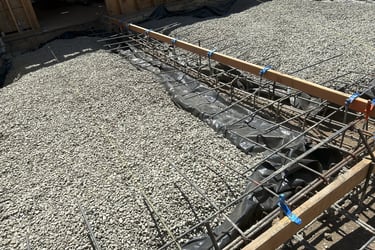
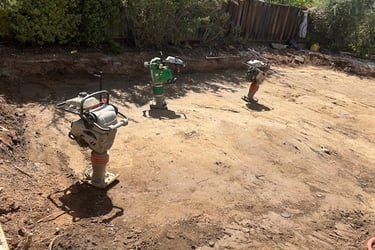
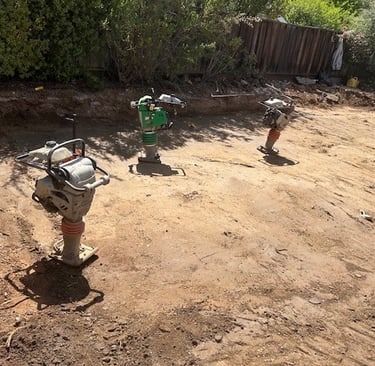
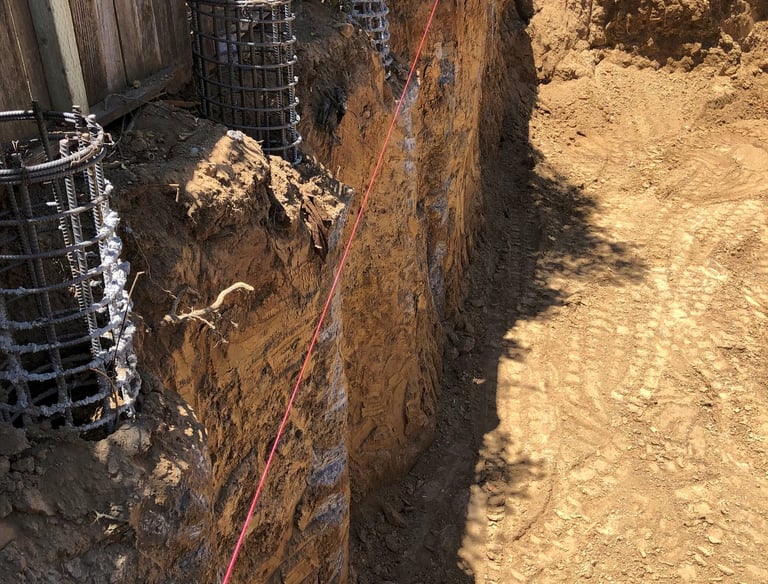
No matter the type of project — whether it’s pool backfill, retaining wall backfill, keyways, utility trenches, or driveway compaction — our team is here to help. We provide reliable compaction and backfilling test services to ensure your project is completed efficiently, and to the highest standard.

The Proctor Compaction Test, named in honor of Ralph Roscoe Proctor, is a laboratory method to determine maximum dry density of soil by determining the optimal moisture content at which a given soil will become most dense, accommodate 4in or 6in Soil Compaction Molds for native soil and imported materials as quarry fines or base rock. The test is commonly used for engineering applications in accordance to ASTM standards to determine how on-site measurements compare with the Proctor test results in the determination of soil density.

Determination of Moisture/Density of Soil and Unit Weight of Soil Specimens

Provide a direct estimate of porosity, void ratio, and the average density of the samples Density is a key element in the phase relations, phase relationships, or mass-volume relationships of soil and rock is also known, dry density can be used to calculate porosity and void ratio.

Atterberg Limits (PI test= plasticity index)

Atterberg limits is a method to test the critical water content of fine-grained soils. These tests include plastic limit, and liquid limit. Depending on the water content of a soil, it may appear in four states: solid, semi-solid, plastic and liquid. The consistency and behavior of a soil is different as are the engineering properties at varying degrees of moisture content. Thus, the boundary between each state can be defined based on a change in the soil's behavior. These limits and tests were developed by Albert Atterberg, a Swedish agriculturist and later, were refined by Arthur Casagrande.

These tests can be used in evaluating various soils, which will ultimately have structures built upon them. Soils when wet retain water, and some expand in volume. The amount of expansion of a soil is related to the ability of it to absorb water and its structural make-up. Atterberg tests are mainly used on clayey or silty soils since these are the soils most affected by expansion and shrinkage due to varying moisture contents.

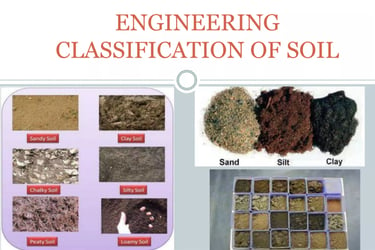
Particle Size Determination Tests of Soil (Sieve Analysis)

Sieve analysis is a method used to determine the particle size distribution of a granular material by passing it through a stack of sieves with progressively smaller openings. The material is separated by size, and the weight of material retained on each sieve is measured to calculate the percentage of particles in each size fraction. This process is used in construction. 

Hydrometer Analysis of Soil

Hydrometer Analysis – Particle Size Distribution of Soils Test, ASTM D422
Hydrometer analysis provides a quantitative evaluation of the particle-size distribution of the material that is smaller than 75μm (No. 200 sieve) found in typical evaluations of fine-grained soils. The test is used in conjunction with a standard sieve analysis of fine-grained soils with a wide range of particle sizes to provide a complete gradation curve. It is also used to more accurately evaluate the sedimentation or fines of a particular soil (separation of clay & silt)

R-Value for Your Pavement Design

The R-value is a measure of a soil's resistance to lateral spreading under load, used in flexible pavement design to determine the required pavement thickness. A higher R-value indicates a stronger, more stable soil that can support a thinner pavement structure. This value is determined through a stabilized test on a saturated soil sample and is calculated from the ratio of applied vertical pressure to developed lateral pressure.  

Expansion Index Testing

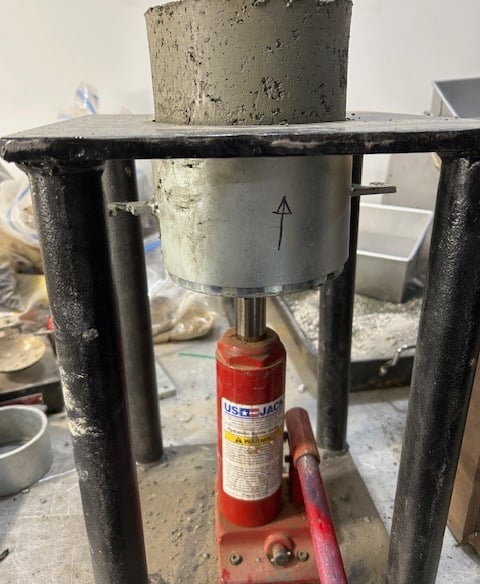
In order to estimate the potential settlement under pavements and structures, soil samples are often tested before and during the construction process. The strength and reliability are observed and measured, providing data to help assure a strong and sturdy structure. Without an even foundation, cracks are prone to form early on. Additionally, proper settlement permits heavy load and overall longevity.

Percolation test ( perc test)

is a soil test used to determine how quickly water drains through the soil. It measures the soil’s permeability—how well it absorbs and filters water.

A perc test is typically done to:

  • Check if the soil is suitable for a septic system
    (A septic drain field needs soil that drains neither too slowly nor too quickly.)

  • Evaluate drainage for construction projects

  • Assess soil quality for agriculture or gardening

  • Determine stormwater management needs

Expansion Index Testing

In order to estimate the potential settlement under pavements and structures, soil samples are often tested before and during the construction process. The strength and reliability are observed and measured, providing data to help assure a strong and sturdy structure. Without an even foundation, cracks are prone to form early on. Additionally, proper settlement permits heavy load and overall longevity.

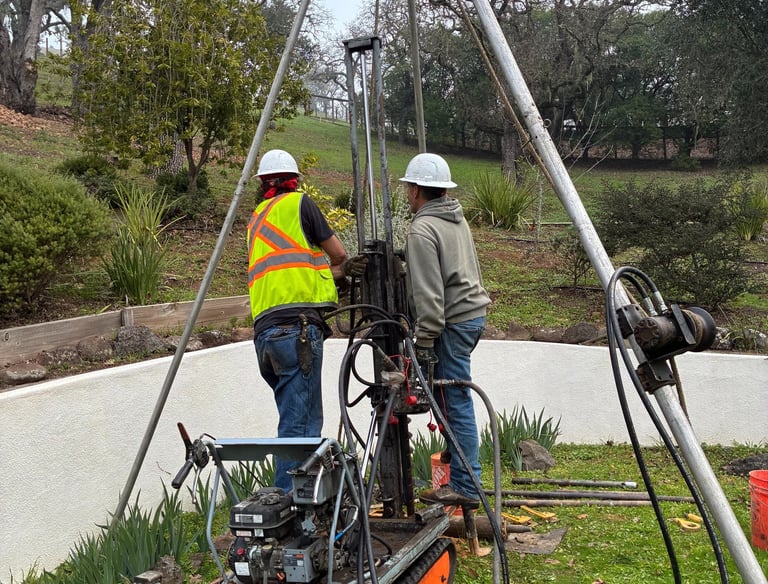
Drilling a boring hole to take a undisturbed or bulk sample for the lab testing.

Please call for

Free Consultation

408-596-3896

Soil engineer testing the density of the compacted matyerial.
Diagram showing Atterberg limits with categories: liquid state, plastic state, semi-solid state, and solid state, alongside a water content scale and consistency limits. To figure out if the soil is expansive or not.
Sieve analysis for soil or imported material to determine the particle size distribution of soil material by passing through the sieves.
Hydrometers to determine the amount of silt and clay in soil.
Soil expansion. Measures soil ability to swell or shrink with changing moisture.

California Soil Testing Inc

Phone: (408) 596-3896